
Case Study
Mavelogx Enterprise
Brand identity, web design and strategy for a B2B sourcing business
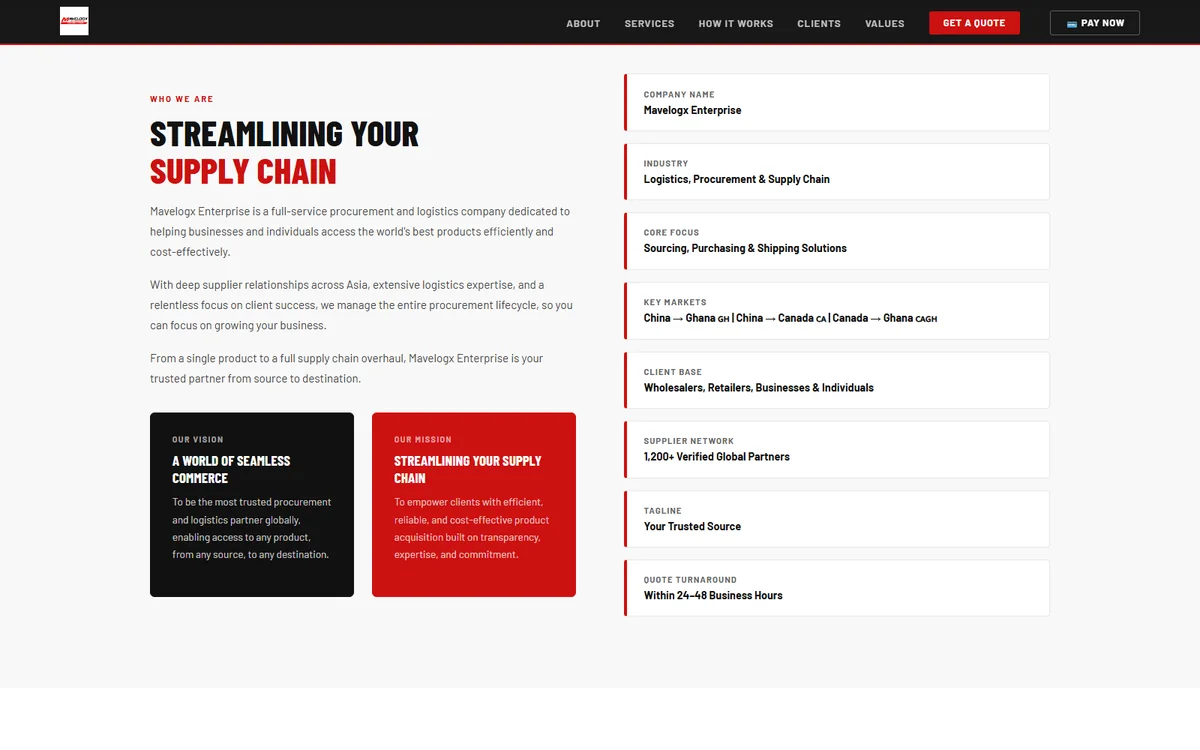
Mavelogx Enterprise connects businesses and individuals to verified suppliers across three trade corridors: China to Ghana, China to Canada, and Canada to Ghana. The problem a procurement site solves is not persuasion but trust. A buyer sending money abroad needs to know what happens, in what order, and who is accountable at each step.
The brief
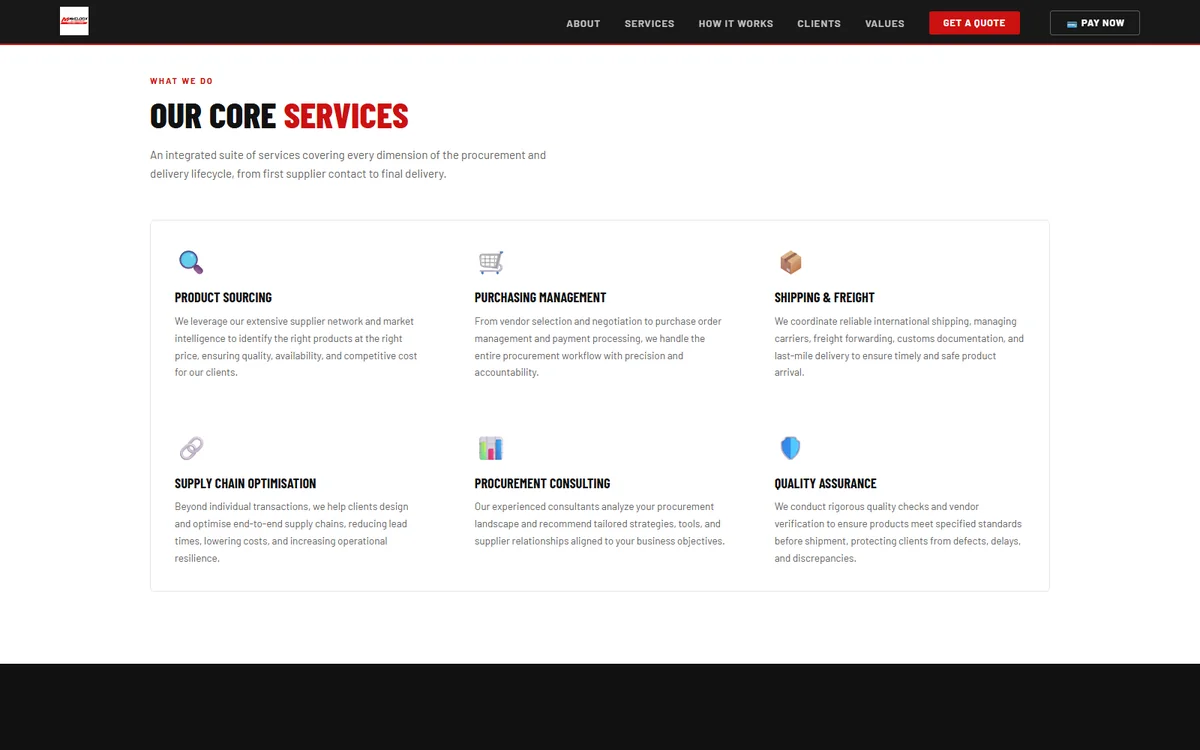
Mavelogx Enterprise is a sourcing and procurement business working three trade corridors: China to Ghana, China to Canada, and Canada to Ghana. It exists because finding a manufacturer is the easy part of importing. A buyer also has to judge whether the supplier is real, settle a price, confirm the goods match the specification, move money across a border, clear customs, and get the shipment to a door. The business takes the whole chain rather than one link of it.
The site has to hold four buyers at once. Wholesalers buying volume, retailers restocking, businesses sourcing equipment and materials to a specification, and individuals importing a single order. The spread is deliberate: orders run from under $1,000 to past $150,000 with no strict minimum. A page pitched at the wholesaler alone reads as closed to the individual, and a page pitched at the individual reads as too small for the wholesaler.
This is an in-house venture, so the brief was argued across a table rather than sent in. The ask was a site that could do the one thing a message thread cannot: let a buyer who has never spoken to anyone at the company understand the offer, follow the process from brief to delivery, and hand over enough detail to be quoted.
The challenge
Before the site, orders arrived two ways. A WhatsApp message, or a phone call. Both are direct, both still work, and that is why WhatsApp sits on every screen of the finished site. The limit was never the channel. It is that either conversation can only begin once someone already has the number, which leaves the business reachable by the people who know it and invisible to everyone else.
The second limit is what those channels capture. A sourcing enquiry carries eight variables before anyone can price it: what the product is, the specification, the quantity, where it is going, when it is needed, how it should ship, what it can cost, and which parts of the job the buyer wants handled. A phone call tends to deliver three of them. A first message usually delivers one, the product, and asks for a price. The rest has to be drawn out across the exchanges that follow, and until it is there is nothing to quote on. That is the real cost, and it was paid in effort and elapsed time rather than in any loss anyone counted.
The objection the site has to answer is not price and it is not interest. It is whether a buyer will send money abroad to a company they found on the internet. Five separate doubts sit under that one. Whether the supplier and the goods are real. Whether what arrives matches what was agreed. Whether the landed cost is knowable before committing. Whether the shipment turns up in a usable timeframe. And who picks up the problem when something goes wrong. Visual polish answers none of the five. A named process, stated in order, with someone accountable at each stage, answers all of them.
Strategy and direction
The obvious version of this site is a catalogue. Products, prices, a basket. It was rejected, and almost everything else follows from rejecting it. A catalogue implies fixed stock at a fixed price, available now. None of those three hold here. The price moves with the supplier, the quantity, the corridor and the week, and a quote for 500 units into Accra tells a wholesaler ordering 10,000 into Toronto nothing at all. A catalogue would have to either invent figures or hedge every one of them, and a hedged price is worse than no price.
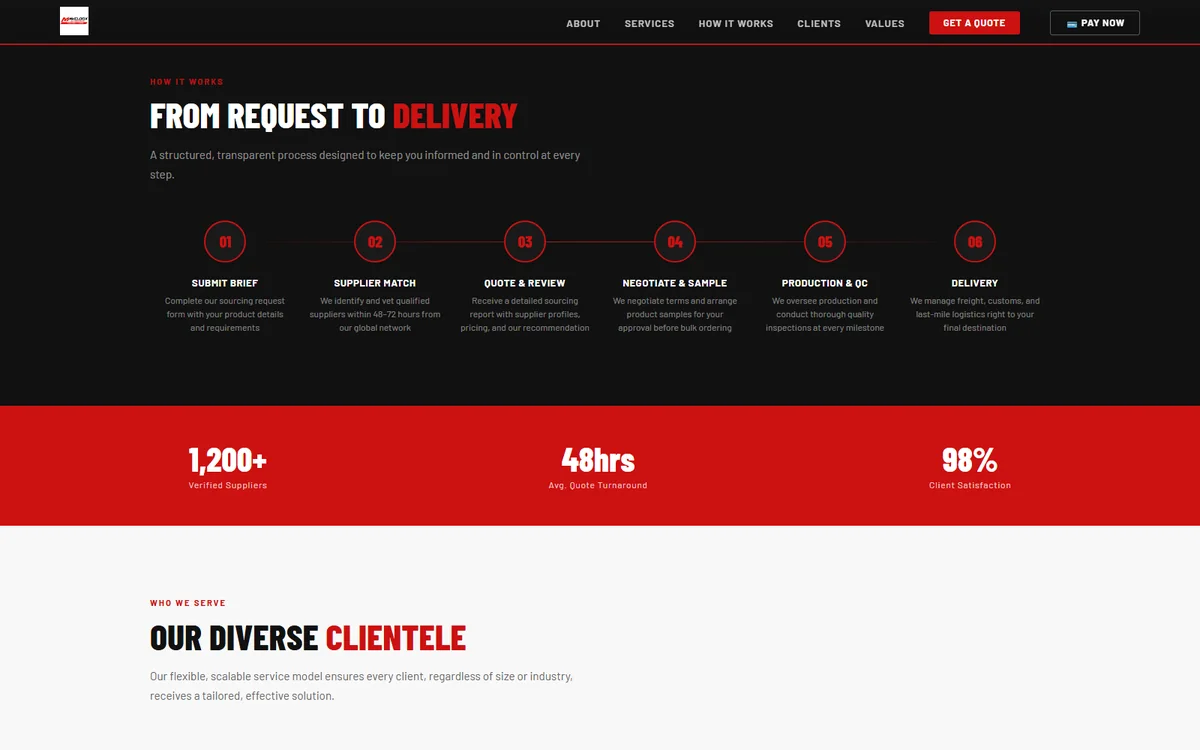
So the site sells the process rather than the goods. Six stages, named and numbered: submit the brief, match the supplier, quote and review, negotiate and sample, production and quality control, delivery. That sequence is the spine of the page, not an explainer tucked under the services. It is there because the thing a first-time buyer is actually buying is somebody else's competence, and competence is only legible as a sequence of steps with a name on each.
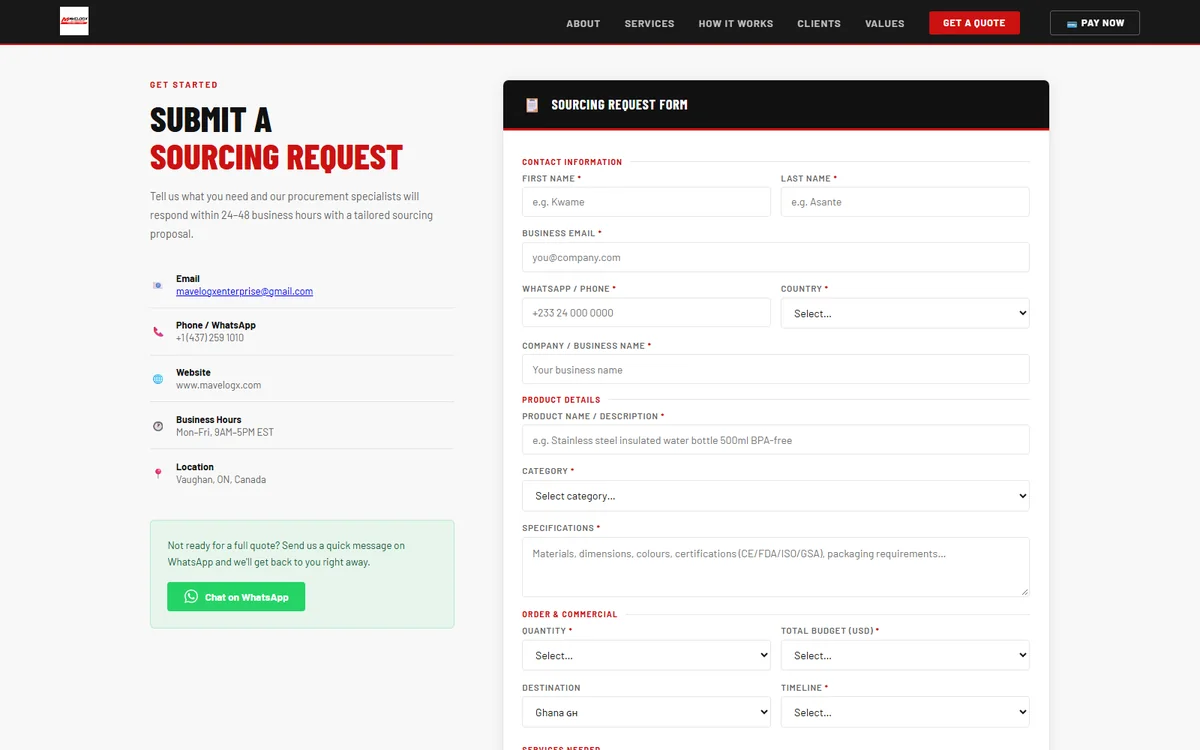
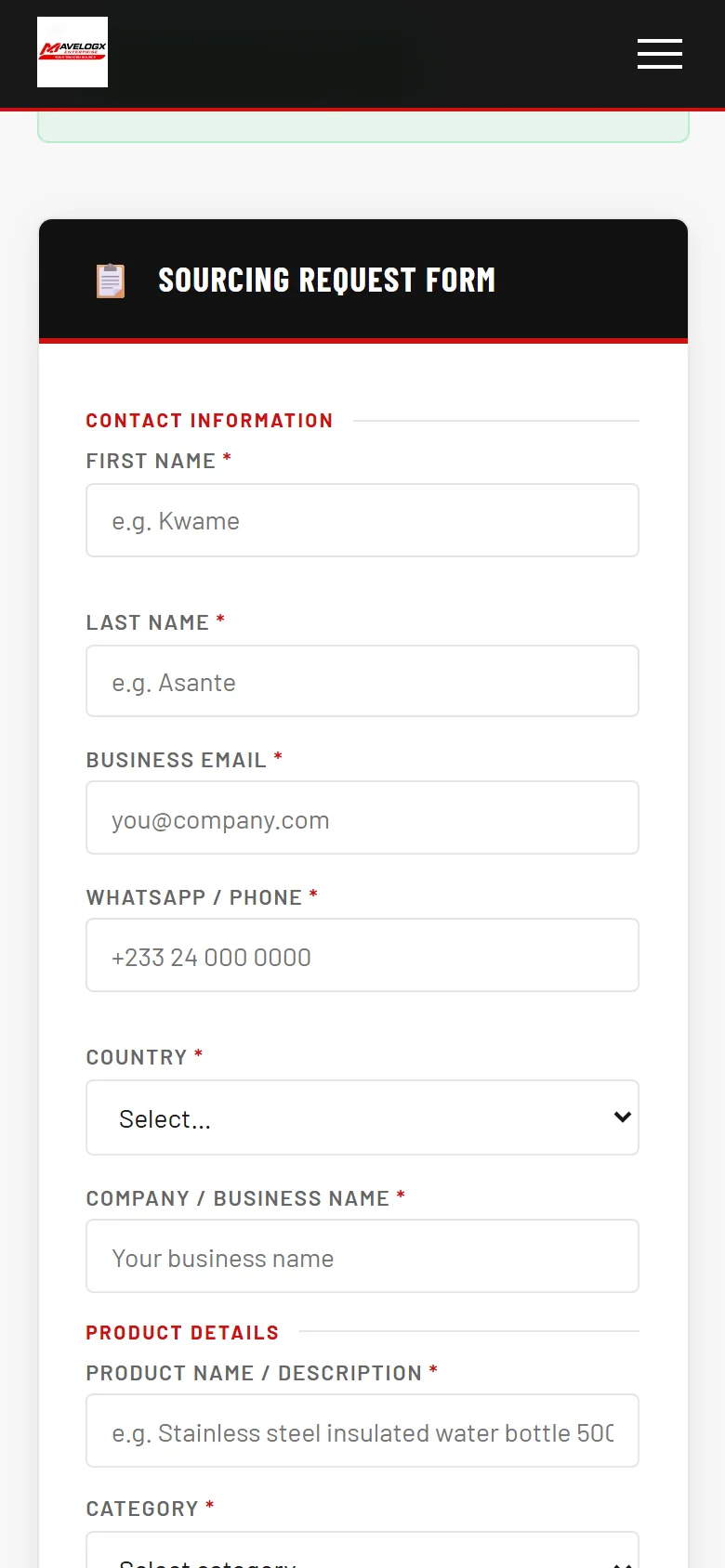
The sourcing request is the instrument of that strategy, not a contact form. It asks for the product, the specification, the quantity, the destination, the timeline, the shipping preference, the cost it has to sit inside, and which parts of the job the buyer wants handled. Asking eight questions before a conversation starts costs some people, and it is worth it: the ones who answer have described a job that can be quoted, and the first reply can be a quote rather than another question.
The trade is deliberate and worth stating plainly. Nobody can buy anything on this site. There is no checkout and no instant transaction, which means the site cannot be judged on conversion the way a shop can. What it can be judged on is whether what arrives is complete enough to act on. That was the brief, and it is the only measure that matches the business.
Identity and design system
One crimson on near-black, and the pairing is the whole system. #CC1111 was drawn for a light ground. It reads 5.74 to 1 on the off-white sections and 3.29 on the near-black that covers most of the site, so it cannot carry small text where the site spends most of its time. That single fact sets every rule that follows. Red takes the display type, the stat figures and the solid fills, where scale and surface do the work instead of contrast. White on the red button reads 5.74, so the primary action clears AA without lightening the brand colour to get there. Body copy on dark goes to a light grey at 11.76 rather than a tinted one, which keeps red rare enough to still mean something wherever it does appear.
#CC1111
#E31E1E
#A00D0D
#111111
#1A1A1A
#F8F8F8
#CCCCCC
#666666
Barlow Condensed at 700 and 800 for display · Barlow for body and controls · DM Sans for the payment module
The build
Key decisions
Lead with the promise, prove it immediately beside it
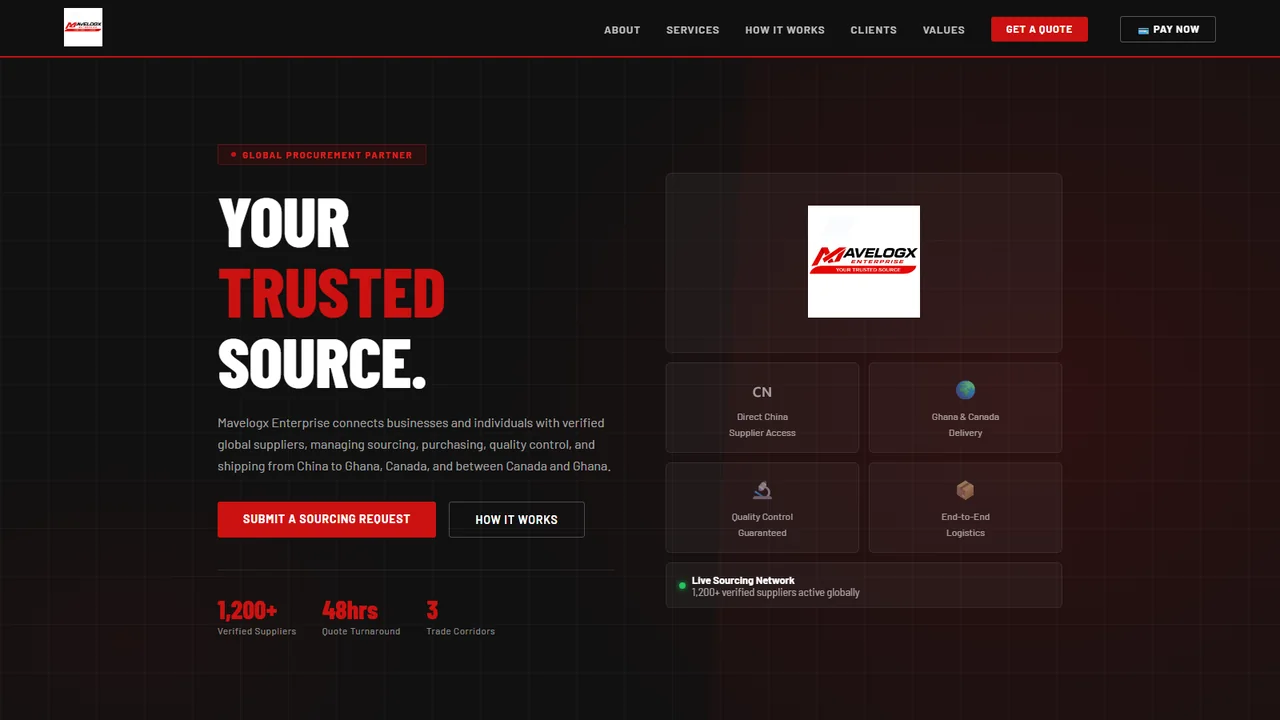
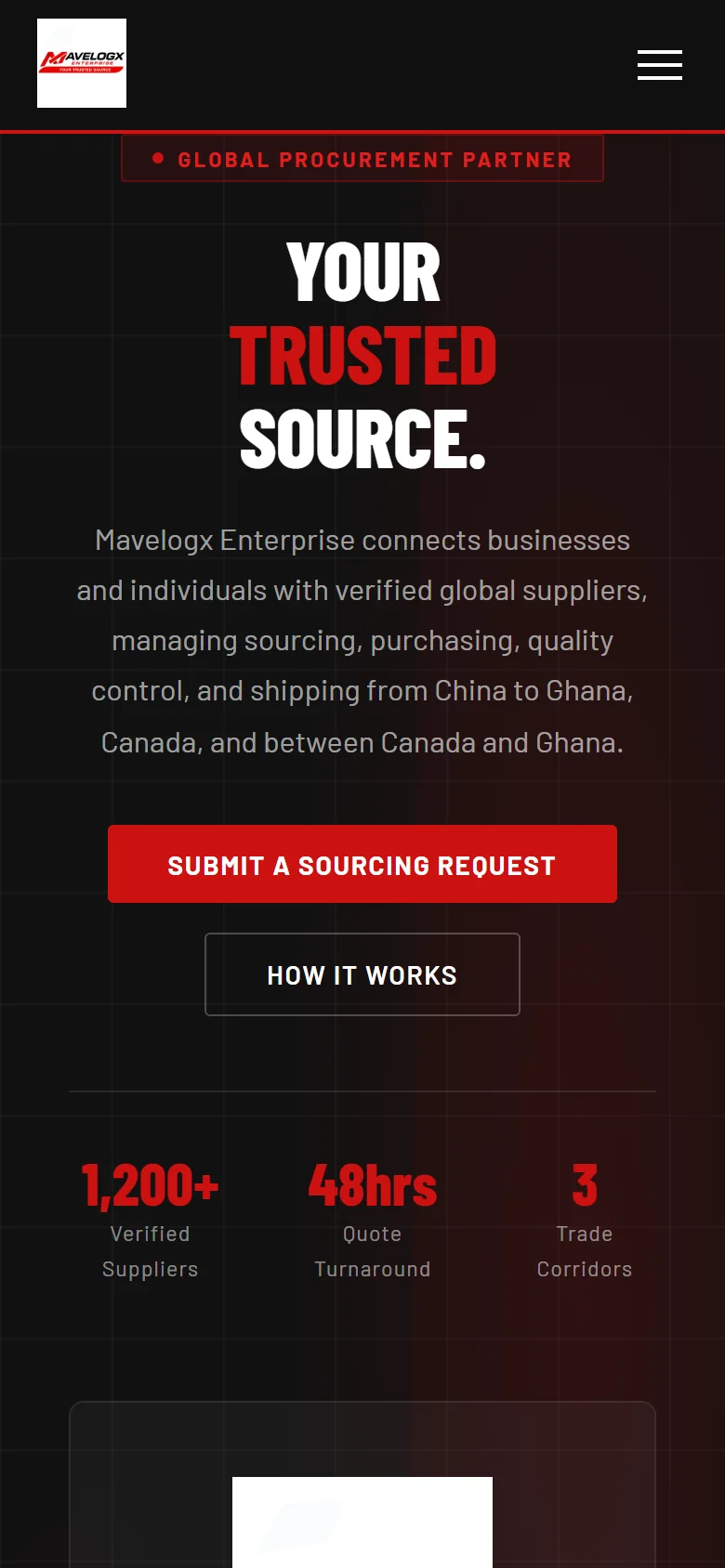
"Your Trusted Source" occupies the left of the hero while a four-cell capability panel sits to its right. Direct China supplier access, Ghana and Canada delivery, quality control, end-to-end logistics. The claim and its evidence share the first screen.
A returning client and a first-time buyer need different doors
"Submit a Sourcing Request" and "How It Works" sit side by side, and "Get a Quote" and "Pay Now" both appear in the header. A returning client settling an invoice and a first-time buyer learning the process need different doors. The header gives them both.
Red is reserved for the next step
The accent is reserved for the action words and the single emphasised line of the headline. On a near-black ground that keeps the next step obvious, even on a page carrying a lot of operational detail.
Next project
Mavel's Corner
Get in touch
Want work like this?
Tell us what you're building and we'll tell you honestly what it needs.