
Case Study
Floks Speaks
Brand identity, website and podcast infrastructure for a Christ-centred spoken-word artist
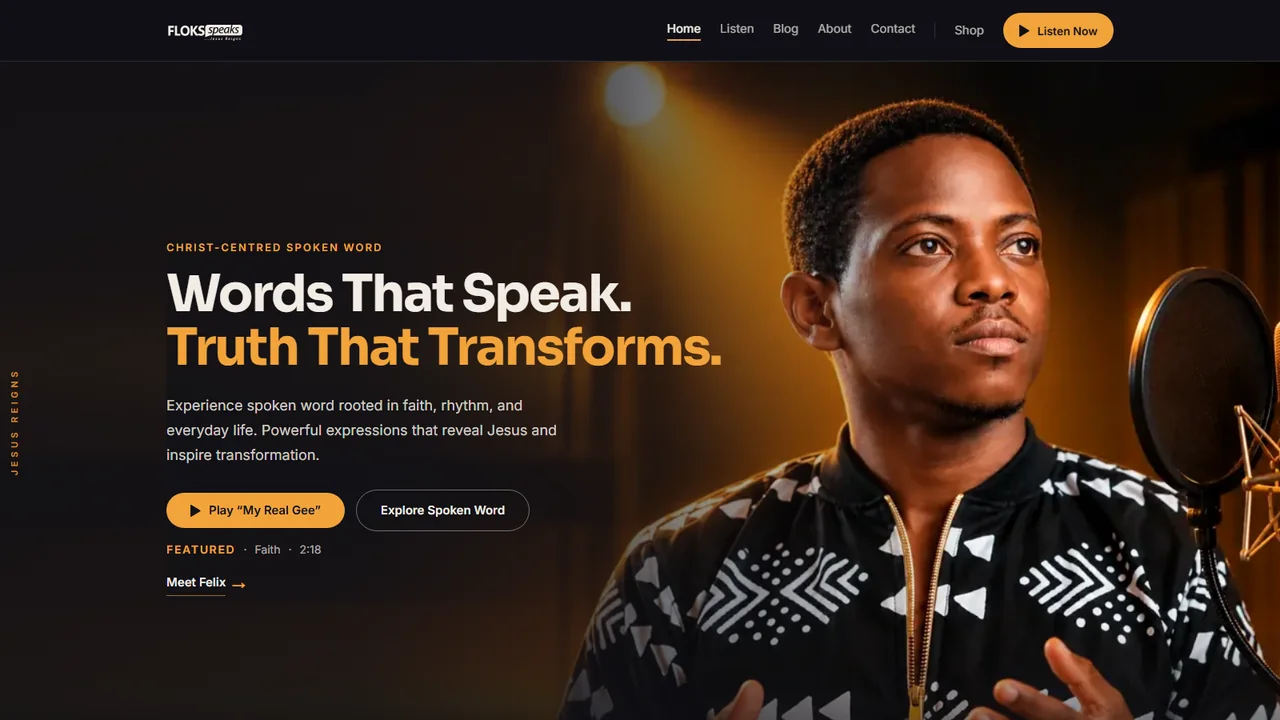
Floks Speaks is the digital home of Felix Lokko, a spoken-word artist working at the intersection of faith, rhythm and everyday life. Eight published pieces lived inside a hosting platform he did not own. No address of his own, no way to publish without a middleman, and no way to take a booking or sell a shirt.
The brief
Felix Lokko is a graphic designer and a spoken-word artist. Floks Speaks is his Christian spoken-word podcast, running since September 2021. Words that cut through the noise, is how he puts it. Each episode is a declaration, a reminder, and a call to return to the one truth that never changes.
The audience is Christian youth and young adults, church communities, and the people who book speakers for youth camps, schools and weddings. Mostly Ghana and the wider continent, with a diaspora audience that finds him through the podcast platforms. They need to hear the work before they will trust it, which puts listening ahead of reading on every screen.
He did not come asking for a brand. He came asking for a home. The podcast already existed and was already distributed. What he wanted was a place that was his.
The challenge
Before this he had social accounts and six podcast platforms, and that was the whole estate. We had built that distribution for him: a Spotify for Creators anchor feed pushing out to Spotify, Apple Podcasts, Amazon Music, iHeartRadio, Deezer and Audible. It worked. It also meant that every episode he published went out through somebody else's pipe.
What it cost him was commercial rather than technical. There was nowhere to show the merchandise. There was no way for a church or a camp organiser to book him without opening a direct message. An artist whose work was reaching six platforms had no address of his own to send anyone to.
The project itself ran without a deadline or a spending limit. The difficulty was all in the engineering. Moving a live podcast off a hosted anchor feed without breaking six downstream platforms is the kind of migration that only announces itself when it goes wrong.
Strategy and direction
The decision the whole project turns on is that Floks Speaks publishes its own feed. He uploads through his own editor, the site generates the RSS, and the six platforms subscribe to him rather than the other way round. He already owned the audience. He was renting the pipe. The site is what ended that.
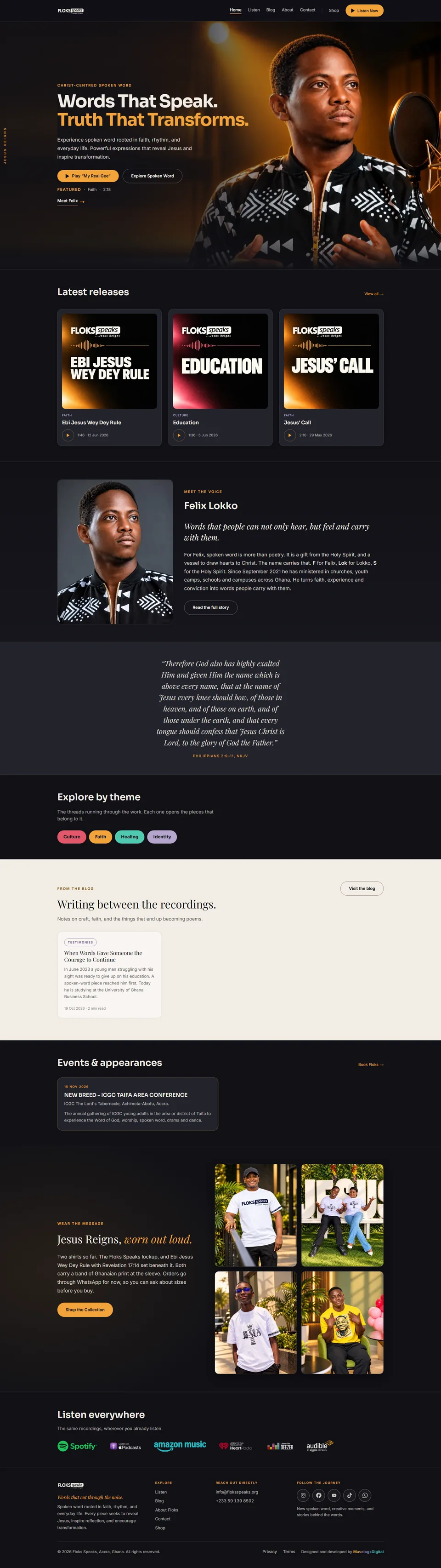
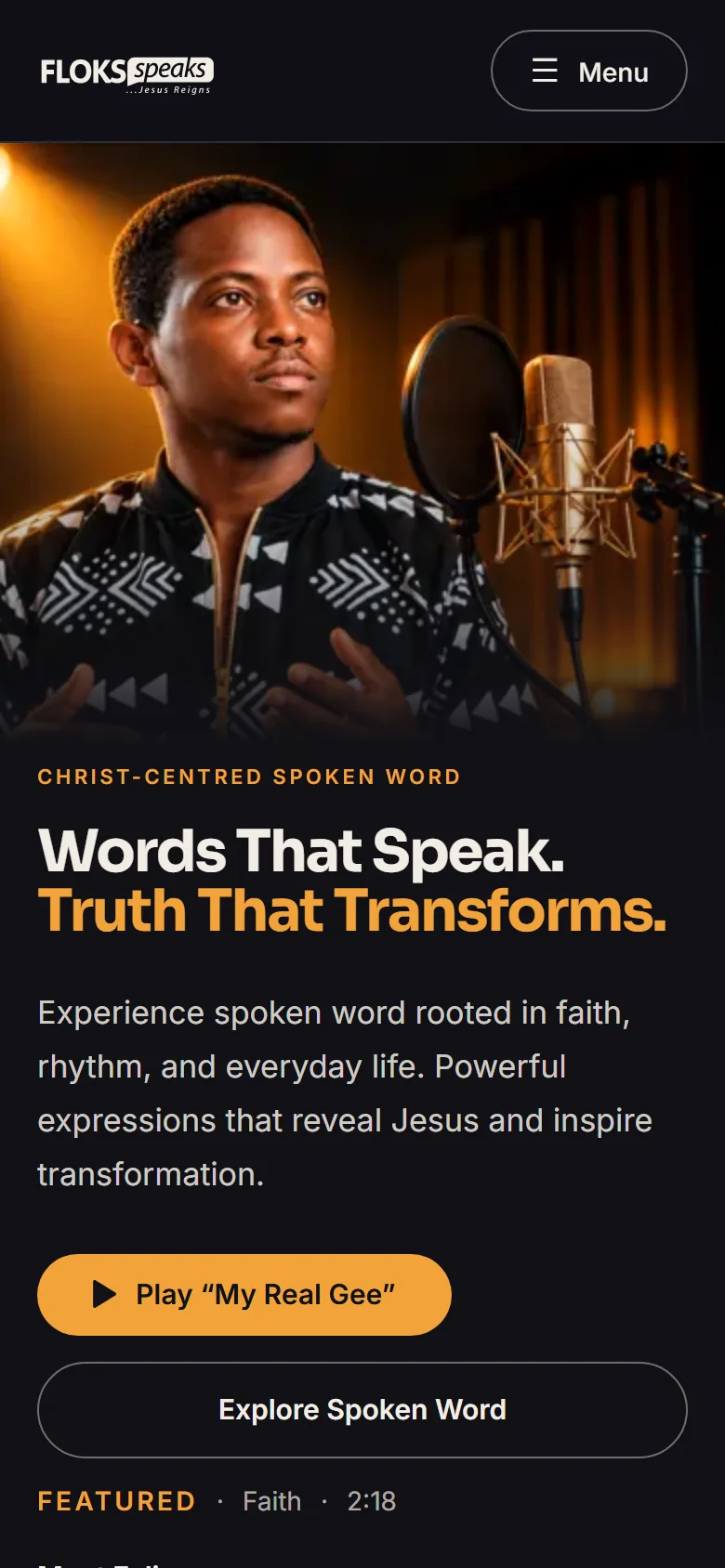
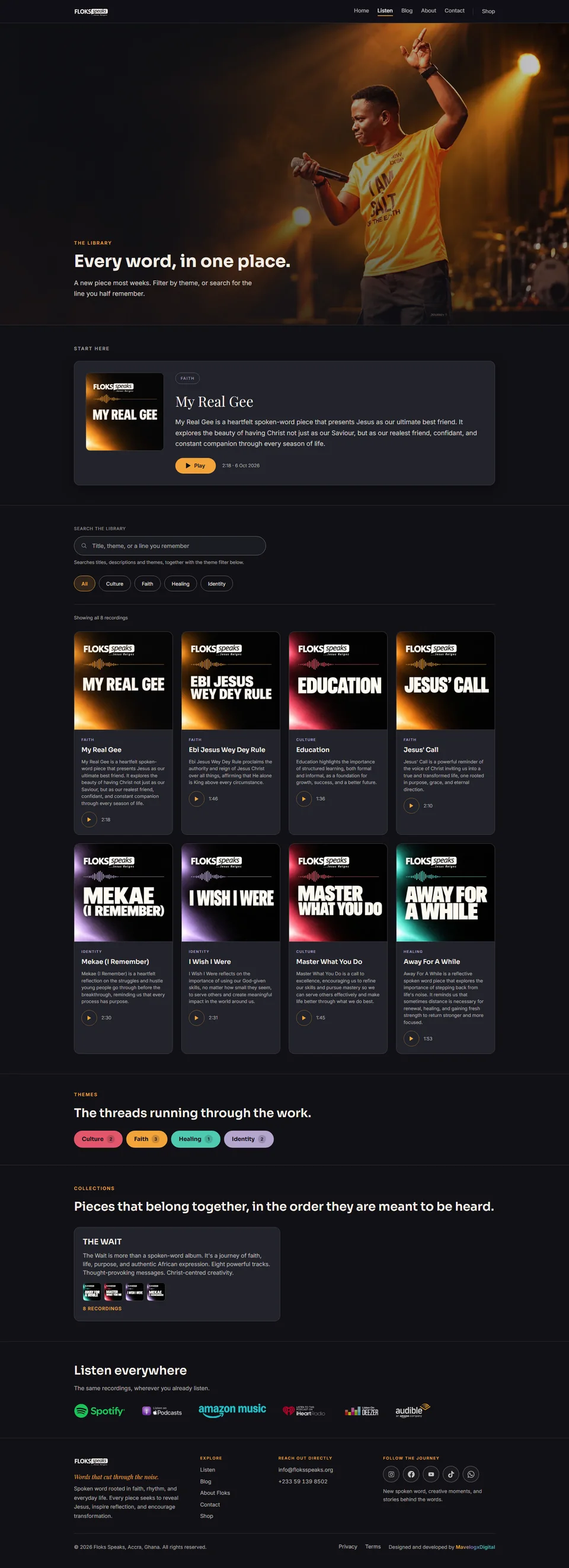
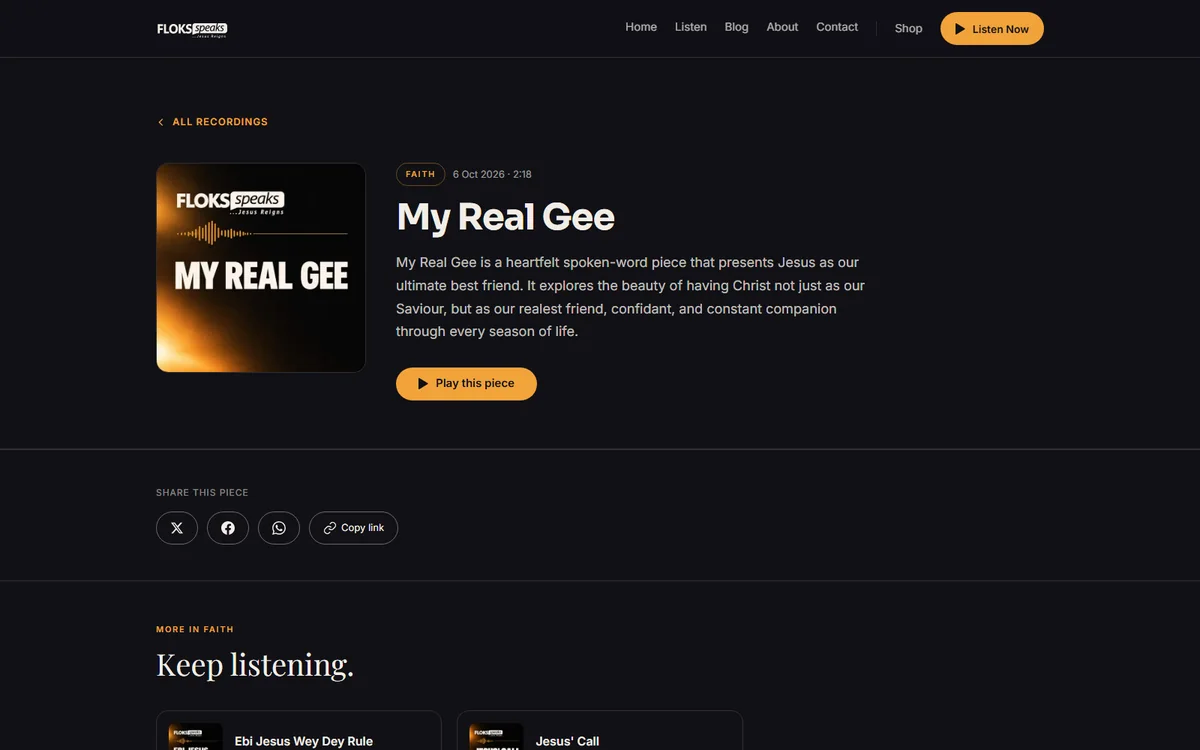
Everything else follows from it. Six pages, plus a page of its own for every recording and every article. A library where search and theme filtering work together. A player that persists across the site, with queue playback and lock-screen controls on a phone. A static front end that stays fast on a mid-range Android device in Accra, which is what his audience is actually holding.
The publishing side is his. He uploads audio straight from the editor, and he posts episodes, articles and events himself with no developer in the loop. Audio sits on storage that does not meter him for being listened to. The six platforms stay exactly where they are, still carrying him, now fed from his own address.
What we rejected was the obvious version: an embedded player pointed at the Spotify feed, with a site wrapped around it. It would have looked the same and shipped faster. It would also have left the dependency untouched, which was the one thing the project existed to fix.
Listening is the primary action. A visitor can hear the work before they have read a sentence about it.
Identity and design system
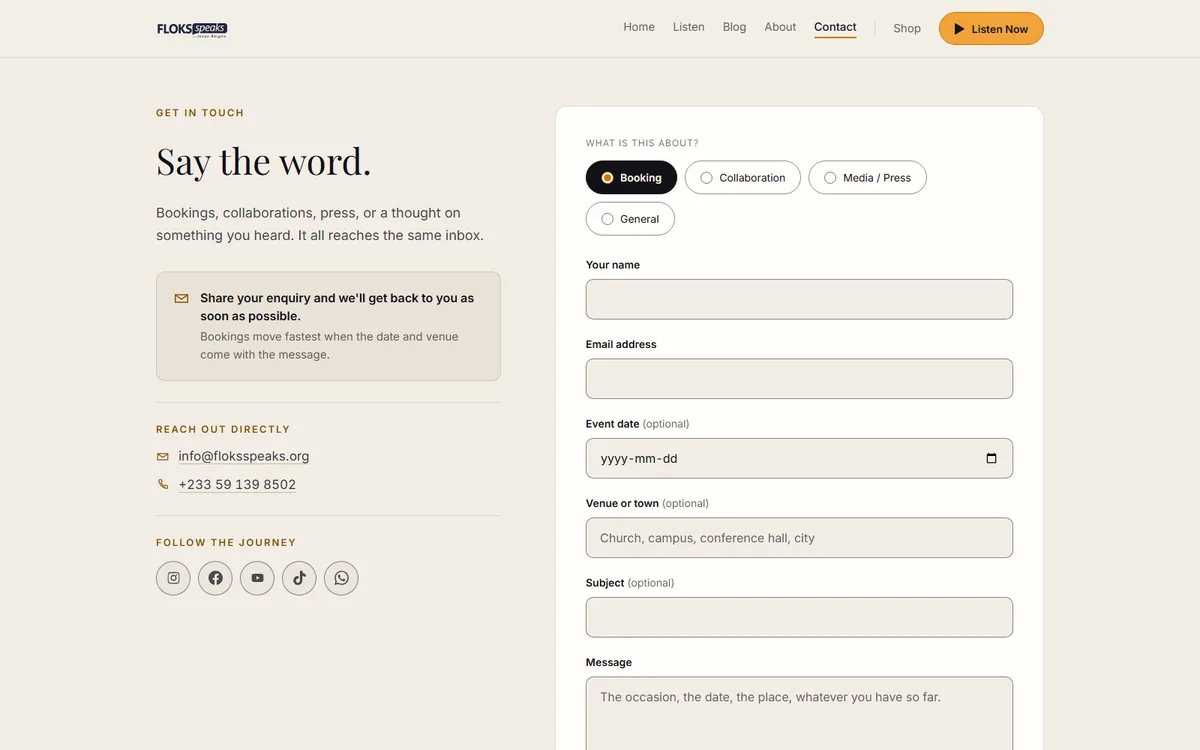
The logo was his and stayed his. The work was building a palette and a type system around it that could carry long-form text without losing the register of a record sleeve. Dark ground, warm ivory text, one amber accent that does the work of a highlight, and a muted lilac held back for the editorial moments. Both accents were measured rather than assumed, and both failed where it mattered. Amber is a comfortable 9.03 to 1 on the near-black ground and collapses to 1.79 on the ivory sections. Lilac does the same, 8.28 down to 1.95. So the light sections carry darker inks of the same hues instead, and the brand colours stay untouched.
#111116
#22232B
#F2EDE5
#F2A33A
#B5A5CE
Sora for display headlines · Playfair Display for poetry and editorial titles · Inter for navigation, body and metadata
The build
Key decisions
The feed was verified episode by episode before cutover
A podcast migration fails quietly. Move a feed badly and directories republish the back catalogue as duplicates, or stop following the show altogether, and nobody is told. The artist finds out weeks later when a new episode reaches no one. So the move was not made on trust. Every episode identifier and every audio file length was checked against the archived original feed first, eight for eight, and only then did the redirect go live. It was held open for thirty days so every directory had time to follow.
The play control comes before the navigation
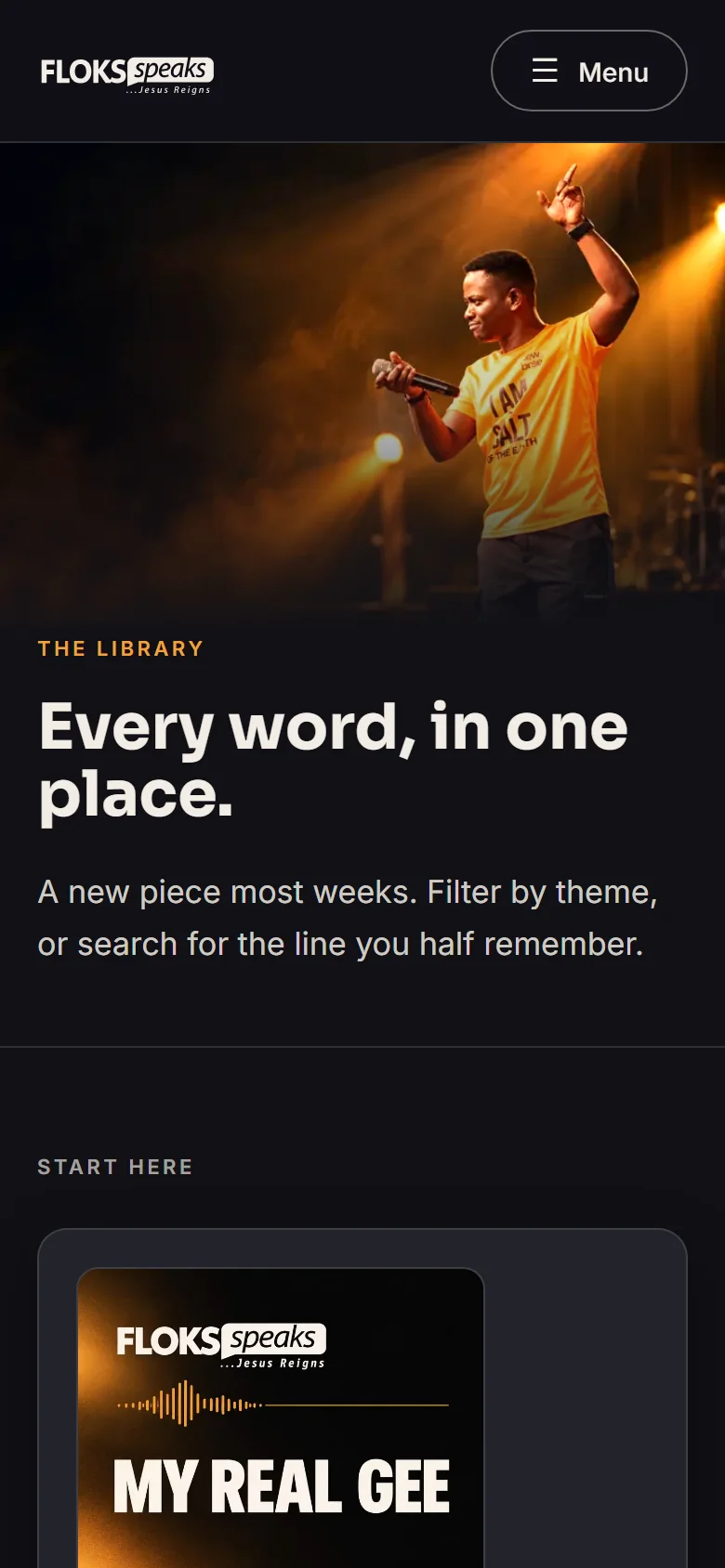
The hero gives a featured track its own play control with the title and runtime visible before any navigation. "My Real Gee", Faith, 2:18. A visitor can hear the work in one click rather than reading about it first, which for a spoken-word artist is the whole proposition.
The identity rests on original studio photography
The identity leans on original studio photography rather than illustration or stock. The hero image is the artist mid-performance, lit warm against a dark field. That sets the register for everything beneath it.
An amber accent on near-black
One warm accent against a dark ground, used for the headline emphasis, the play control and the eyebrow. The restraint keeps it feeling like a record sleeve, not a church bulletin.
Outcome
He is getting booked through the site. Since launch the contact form has brought in church programmes for November and December 2026 and a run of wedding engagements. That is the difference between a request he might miss in a message thread and one that waits for him in one place.
He publishes without us. Episodes go up through his own editor and out through his own feed, and the six platforms carry them as they always did.
The merchandise has somewhere to live and is selling. Ordering still runs through WhatsApp while the shop is finished, so that leg has not moved yet. Booking has.
He owns his feed, his audio, his domain, his email address and his words. He publishes without asking anyone, and a booking enquiry reaches him at his own name rather than a free mailbox.
Next project
Syndei Embassy
Get in touch
Want work like this?
Tell us what you're building and we'll tell you honestly what it needs.